Tuesday, 8 November 2016

Wearable Robot Helps Paralytic People Walk

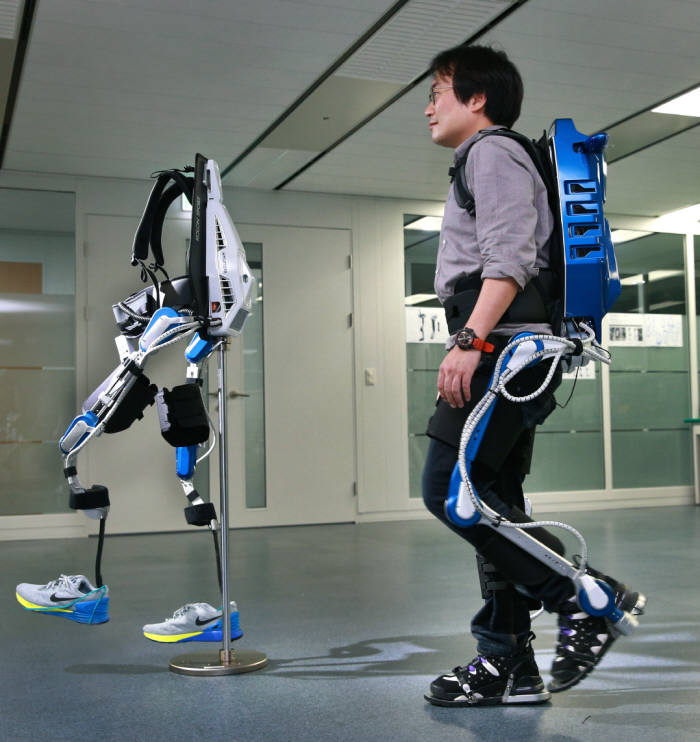
Scientists have designed a wearable lower limb robot exoskeleton with natural knee movement to help stroke and spinal cord injury patients regain the ability to walk and strengthen their muscles. Wearable “robot-assisted training” is quickly emerging as a method to improve gait rehabilitation. Researchers from Beihang University in China and Aalborg University in Denmark said that the robotic exoskeleton was intended to help stroke patients strengthen their physical fitness, aid the rehabilitation training of paralyzed patients, or to assist those who need help performing daily activities. The team focused on the knee joint, one of the most complex mechanical systems within the human body and a critical player during gait. The knee joint’s motion is actuated by several skeletal muscles along its articular surfaces and its centre of rotation moves. Researchers wondered if a parallel mechanism similar to skeletal muscles would be useful for designing a bionic knee joint. This design features a parallel knee joint to improve the bio-imitability and adaptability of the exoskeleton. The exoskeleton taps a hybrid serial parallel kinematic structure consisting of a one degree of freedom (DOF) hip joint module and a 2-DOF knee joint module in the sagittal plane. A planar 2-DOF parallel mechanism helps to fully accommodate the motion of the human knee – enabling rotation and relative sliding. When wearing the exoskeleton, its movement should be synchronized and consistent with a patient’s natural movement.

Explained: Why Pints Spill But Straw Do Not

It is not only the size, but the shape of a tube that determines whether a liquid will spill out of it when tipped over. Glasses of liquid, when turned horizontally, inevitably spill. This is not necessarily the case, however with thin straws, which, when turned on their sides, can retain liquid in them. This simple relationship was thought to be based on the size of the tube opening but researchers from University of Oxford have determined that this rule does not always hold true. The shape of the tube turns out to be important too, and if it is squashed enough – forming an elliptical shape – then no matter how thin the straw is the liquid will always spill out. This new discovery has applications in technologies that deal with liquids on small scales – such as biomedical diagnostics, oil recovery and inkjet printing – where choosing the right tube shape could be as important as its size.

'Martian' Redux? NASA Plants Lettuce On ISS

NASA has planted lettuce on the International Space Station to learn how to grow fresh food in space which may help prepare astronauts for future manned mission to Mars. Astronaut Shane Kimbrough initiated the Veg-03 experiment, one of his first science assignments, and has planted the third on orbit crop of red romaine lettuce. Operations were little slower than expected, but all plant pillows were successfully primed for the first time in Veg series. Plant pillows are small pouches containing a growth medium, fertilizer and seeds. The Veg-03 crop will be the team’s first on-orbit attempt at a new, repetitive harvest technique termed ‘Cut-and-Come-Again’. Once the plants are four weeks old, a selection of leaves can be harvested for a bit of fresh lettuce.

Monday, 7 November 2016

This 3D-Printed Bone Implant Dissolves In Body

In a major step towards improving surgeries after head or face injuries, scientists have developed a new type of 3D-printed polymeric bone implants that can survive in the body for long periods and be subsequently replaced with natural bone tissue in the body. The implant is coarctate and thus shielded from the mechanical impact of surgery, and it ‘unfolds’ at a certain temperature during the surgery. Researcher said that the implant could be 3D printed at the selected dimensions, compressed twice in protective, biodegradable shelling, heated during the surgery and eventually fix into the renovated area of bone tissue without using blocking devices and fasteners used in transplantology. Researcher has applied the shape memory effect in a polymeric composite material based on polylactide. Researcher have developed a technology stacking multi-potent mesenchymal stromal cells, a bioengineering structure isolated from a patient’s bone marrow, which stimulates the formation of blood vessels and tissue inside the implant, thus optimizing the process of survival and increasing the efficiency of transplantation.

Soon, Screens That Remotely Charge Phone

A flat screen panel that resembles a TV on your living room wall could one day remotely charge smartphones and tablets within its line of sight, making dead batteries a thing of the past, according to new research. Scientists said that the technology already exists to build such a system. There is an enormous demand for alternatives to today’s clunky charging pads and cumbersome cables, which restrict the mobility of a smartphone or a mobility of a smartphone or a tablet. The ability of safely direct focused beams of microwave energy to charge specific devices, while avoiding unwanted exposure to people, pets and other objects, is a game changer for wireless power.

Baby Is 'Born' Twice After Miracle Surgery In US

A baby girl in the US was successfully ‘born’ for the second time, after being taken out of her mother’s womb for 20 minutes at 23 weeks of pregnancy for a groundbreaking surgery to save her life. The baby was delivered by C section after 12 weeks. Margaret Boemer, from the US, was 16 weeks pregnant when she was told that her baby had a sacrococcygeal teratoma – a tumour grows from the baby’s tailbone before birth. This is the most common tumour doctors see in a newborn. Even though it’s the most common they see, it was still a pretty rare. According to doctor, the tumour feeds on blood flow from the baby, competing with the baby as they both are trying to grow. In some instances, the tumour wins and the heart just can’t keep up and the heart goes into failure and the baby dies. At 23 weeks, the tumour was shutting her heart down and causing her to go into cardiac failure, so it was a choice of allowing the tumour to take over her body or giving her a chance at life. An emergency surgery was performed at 23 weeks and 5 days of pregnancy, when the tumour was nearly larger than the foetus. The tumour was so large a huge incision was needed to reach it, so the baby had to be taken out of the womb. The team successfully removed the bulk of the tumour. When they finished their operation, the surgeon placed the baby back inside the womb and sewed her mother’s uterus shut. After another 12 weeks Lynlee Hope was born for the second time via C-section in June this year.

Self-Driving Truck Makes First Delivery: 45,000 Cans Of Beer

In the first real-world commercial use of autonomous trucking, some 45,000 cans of Budweiser beer arrived late last week of October to a warehouse after travelling over 120 highways miles (193 km) in a self-driving truck with no driver at the wheel, executives from Uber and Anheuser Busch said. Otto, the self-driving truck subsidiary of Uber, shipped a truckload of Budweiser from Fort Collins, Colorado Springs on 20 October with the driver monitoring from the truck’s sleeper berth for entire two hour journey, Otto’s co-founder Lior Ron and Anheuser-Busch’s senior director of logistics strategy, James Sembrot, said. The truck made the trip using only its panoply of cameras, radar and sensor to read the road. The early morning drive at an average speed of 55 mph (89kmph) marks what the two executives said was the first revenue generating load transported via autonomous truck. Otto was paid the market rate of $470 for the job using one of its trucks outfitted with the new technology. Otto and Anheuser-Busch enlisted the support of the state of Colorado before the drive, and the state patrol monitored it, although Colorado and most other US state do not expressly prohibit self driving trucks. The only time the truck driver delivering the beer took to the wheel was while driving on and off the highway ramp. Transportation experts predict the earliest applications of autonomous technology will be in self-driving trucks, not cars. The technology is best suited to the relative predictability of long hauls on highways, rather than busy city streets with many distractions. Another Silicon Valley company, Peloton Technology, is testing driver assisted “platooning” in which trucks communicate, travelling in close formation to reduce drag and save on fuel, while increasing safety. Otto, co-founder by Google car and map project veterans Anthony Levandowski and Ron, was acquired in August by Uber, which is trying to advance self-driving technology in its ride services business. Ron told Reuters that Otto plans to involve more commercial partners and independent drivers who will use the technology, designed to increase safety and decrease costs as the truck is able to be operated 24 hours a day and 7 days a week. The biggest cost savings for the trucking industry will eventually come from eliminating the driver entirely, but Ron said drivers would remain inside the trucks “for the foreseeable future.”