Friday, 16 December 2016

Experts Inch Closer To 'Star In Jar' Reactor

Scientists have taken a big step towards developing a ‘star in a jar’ nuclear fusion reactor that can provide Earth with limitless clean energy in the same manner as the Sun and other stars. The Wendelstein 7-X (W7-X) fusion energy device currently operated by Max Planck Institute for Plasma Physics in Germany is on track and working as planned, experts said. The system, known as a stellerator, generated its first batch of hydrogen plasma when it was first fired up earlier this year. A fusion reactor works by fusing the nuclei of lighter atoms into heavier atoms. The process releases massive amounts of energy and produces no radioactive waste. The ‘fuel’ used in a fusion reactor is simple hydrogen, which can be extracted from water. However, to achieve fusion, scientists must generated enormously high temperatures to heat the hydrogen into a plasma state, ‘Live Science’, reported. That is where the W7-X stellerator design comes in. the device confines the plasma within magnetic fields generated by superconducting coils cooled down to near zero. The plasma never comes into contact with the walls of the containment chamber.

Japan Launches Craft To Collect Space Junk

Japan launched a cargo ship on Friday bound for the International Space Station, carrying a ‘space junk’ collector that was made with the help of a fishnet company. The vessel, dubbed “Kounotori” (stork in Japanese), blasted off from the southern island of Tanegashima just before 10:27pm on 9 December local time attached to an H-IIB rocket. Scientists at the Japan Aerospace Exploration Agency are experimenting with a tether to pull junk out of orbit around Earth, clearing up tonnes of space clutter including cast-off equipment from old satellites and pieces of rocket.

Virus In Mummy May Rewrite Smallpox History

The discovery of smallpox DNA in a 17th century child mummy may shorten the timeline of the deadly infectious diseases history, according to a study published on 8 December. Specimens of the smallpox causing variola virus now exist only in secured laboratory freezers. The highly contagious and sometimes fatal disease was eradicated in the late 1970s through a worldwide vaccination campaign. But the origins of the virus remain unknown. The discovery of the smallpox virus within the DNA of the mummy child, found in a crypt underneath a Lithuanian church, could shed light on how it began and developed, researchers said in the study published in the US scientific journal Current Biology. There have been signs that Egyptian mummies that are 3,000 to 4,000 years old have pock-marked scarring that have been interpreted as cases of smallpox. The new discoveries really throw those findings into question, and they suggest that the timeline of smallpox in human populations might be incorrect. The researchers reconstructed the genome of the ancient strain of the virus and compared it with versions of the variola virus genome dating from the mid-1900s and before its eradication.

Trove Of Water 400Km Beneath Earth's Surface

Seventy percent of the Earth’s surface is water. But that’s what just meets the eye. A trove of water – in fact as much water as all the oceans on the planet’s surface combined – is hiding 400km beneath our feet. Geoscientists had earlier thought that below the transition zone where the Earth’s mantle meets the crust (at 410km), a water filled mineral called brucite was unstable and decomposed. As they decomposed; they released the water, which was recycled back to surface via volcanic activity. But this discovery of a new high-pressure phase of brucite indicates that water could be efficiently transported to far deeper realms without decomposition, reports LiveScience.com. But new research suggests that before brucite which is 50% magnesium oxide and 50% water – decomposes, it transforms into another, more stable 3D structure. The finding, which was detailed in the journal Proceedings of the National Academy of Sciences, means there’s a stash of water located deeper in the Earth than was previously thought. Unable to probe the deep Earth directly, researchers used quantum mechanical calculations, analyzing various possible structures for brucite in deep Earth conditions. After months of running various structure through their computer programme, the researchers found a previously unknown phase of brucite that would be able to withstand the high pressures found in the lower mantle. Current estimates suggest that the deep Earth may hold as much water as all the oceans on the planet. This water and the additional trove brucite may also hold, are vitally important to the movement of materials through the Earth. As water containing minerals travel down through the Earth’s layers, the materials decompose, releasing the water that makes its way back to the surface, often through volcanic activity.

Wednesday, 14 December 2016

Experts Digitally Unwrap Secrets Of Mummies

The hidden secrets of Egyptian mummies, some up to 3,000 years old, have been virtually unwrapped and reconstructed for the first time using scanning technology in a joint British-Australian exhibition. Three-dimensional images of six mummies aged between 900BC and 140-180AD from ancient Egypt, which have been held at the British Museum but never physically unwrapped, give an insight into what it was like to live along the Nile River thousands of years ago. Researchers are revealing details of all their physical remains as well as the embalming material used by the embalmers like never before. A dual-energy computed tomography scanner at UK’s Royal Brompton Hospital – only a handful are in operation around the world – was used to obtain thousands of slices of images of the mummies, with volumetric software then harnessed to create 3D models. It allows visitors to virtually peel back the layers of history through interactive 3D visualizations of the CT scans. Researchers have been able to image the arteries of the mummies and able to look at whether they are suffering from diseases which many people are suffering from today, such as cardiovascular diseases. They hope to image the soft tissues at the cellular level to look at whether there’s any change or to find evidence, for example, of cardiovascular diseases but also things like cancer. The scans found that one of mummies, Tamut, a priest’s daughter from 900BC, had plaque in her arteries. Three dimensional printing was also used to recreate amulets fond during scans of her mummified remains.

Tequila Plant May Inspire Drought Resistant Crops

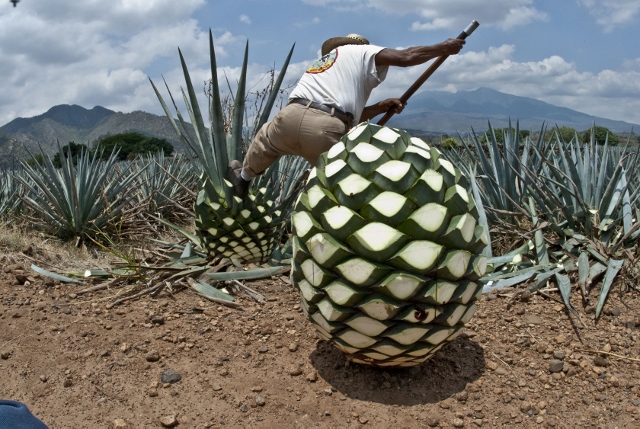
Agave – the cactus like plant used to make tequila – can survive the driest of conditions by “breathing” at night, scientist has found. Now, they hope to harness the plant’s reverse “body clock” to engineer drought-resistant crops that can adapt to changing climate. Researchers from Newcastle University found for the first time that the stomata – or “breathing” pores – on the Agave’s leaves remain shutting during the day to minimize water loss. Most plants keep their stomata open during the day so they can take in carbon dioxide and use the sunlight for photosynthesis. Thus, they lose water rapidly through evaporation. In the so-called CAM plants – Crassulacean Acid Metabolism plants like the Agave – several of the genes controlling stomata opening have had their abundance rescheduled or ‘flipped’ from being more abundant during the day to more abundant at night. Storing the carbon from the CO2 taken up overnight, the plants photosynthesis in the day like others but are able to carry out the process without opening their stomata.

Barcodes Help Families Track Elderly Members

A Japanese city has introduced a novel way to keep track of senior citizens with dementia who are prone to getting lost – tagging their fingers and toes with scanable barcodes. A company in Iruma, north of Tokyo, has developed tiny nail stickers, each of which carries a unique identity number to help concerned families find missing loved ones, according to the city’s social welfare office.  The adhesive QR-coded seals for nails – part of a free service launched this month and a first in Japan – measure just one centimeter (0.4 inches) in size. Being able to attach the seals on nails is a great advantage. There are already ID stickers for clothes or shoes but dementia patients are not always wearing those items. If an elderly person becomes disoriented, police will find the local city hall, its telephone number and the wearer’s ID all embedded in the QR code. The chips remain attached for an average of two weeks- even if they get wet – the official said, citing recent trials. Japan is grappling with a rapidly ageing population. Senior citizens expected to make up 40% of the population around 2060. Last month, Japanese police started offering noodle discounts at local restaurants to elderly citizens who agreed to hand in their driving licenses. The offer followed a series of deadly accidents involving elderly drivers – a growing problem in a country where 4.8 million people aged 75 of older hold a license.