Wednesday, 10 August 2016

Hoped for Particle just a 'Blip'

                A great “might have been” for the universe, or at least for the people who study it, disappeared Friday. Last December, two teams of physicists working at CERN’s Large Hadron Collider reported that they might have been traces of what could be a new fundamental constituent of nature, an elementary particle that is not part of the Standard Model that has ruled particle physics for the last half-century. A bump on a graph signaling excess pairs of gamma rays was most likely a statistical fluke, they said. But physicists have been holding their breath ever since. If real, the new particle would have opened a crack between the known and the unknown, affording a glimpse of quantum secrets undreamed of even by Einstein. On Friday, physicists from the same two CERN teams said that under the onslaught of more data, the possibility of the particle had melted away.

Vitamin-driven battery for cheaper electronics

                Scientists have created a new vitamin-driven battery that is long-lasting and has a high voltage, paving the way for cheaper consumer electronics that are easier on the environment. The battery is similar to many commercially available high-energy lithium-ion batteries with one difference. It uses flavin from vitamin B2 as the cathode – the part that stores the electricity that is released when connected to a device. “We have been looking to nature for a while to find complex molecules for use in a number of consumer electronic applications,” said Dwight Seferos from University of Toronto in Canada. While bio-derived polymers – long-chain molecules – for one of the electrodes, allowing battery energy to be stored in a vitamin-created plastic, instead of costlier, harder to process and more environmentally-harmful metals such as cobalt.

An App to magnify phone screen

An application that can magnify a smartphone screen to potentially benefit low-vision users has been developed by researchers. The smartphone application projects a magnified smartphone screen to GoogleGlass, which users can navigate using head movements to view a corresponding portion of the magnified screen, researchers said.

The technology can benefit low-vision users, many of whom find the smartphone’s built in zoom feature to be difficult to use. “When people with low visual acuity zoom in on their smartphones, they see only a small portion of the screen, and it is difficult for them to navigate around – they do not know whether the current position is in the centre of the screen or in the corner of the screen,” said Gang Lou from Harvard Medical School. People with low vision often have great difficulty reading and discerning fine details. Magnification is considered the most effective method of compensation for visual loss, researchers said.

SpaceX successfully landed its rocket on a floating ship for the first time

On 9 April 2016, American aerospace company SpaceX achieved the historic feat of successfully launching Falcon 9 rocket. The rocket landed on a drone ship at sea after being launched into space. This was the first time that the company succeeded in landing the rocket in Ocean. The feat was achieved after the company failed to do so in its four previous attempts. This feat also is important because the landing proved that SpaceX can land its rocket both on solid ground and Ocean. This was the second time SpaceX successfully landed one of its rockets post-launch, the first time was on 21 December 2015, when the company’s Falcon 9 rocket touched down at a ground-based landing site in Cape Canaveral, Florida, after putting a satellite into space.

Tuesday, 9 August 2016

'Ring' to turn arm into touchpad

                Scientists have developed a new wearable technology that may be able to turn your entire lower arm into a touchpad for a smartwatch. Called SkinTrack and developed by researchers from the Carnegie Mellon University in the US, the new system allows for continuous touch tracking in the hands and arms. It also can detect touches at discrete locations on the skin, enabling functionality similar to buttons or slider controls, researchers said. SkinTrack requires only that the user wear a special ring, which propagates a low-energy, high-frequency signal through the skin when the finger touches or nears a skin surface, researchers said.

Coming, bee-inspired flying bots

                Scientists have created a computer model to look at how bees use vision to detect the movement of the world around them and avoid crashes, a breakthrough which could help develop autonomous flying robots. Bees control their flight using the speed of motion – or optic flow – of the visual world around them, but it is not known how they do this, said researchers at the University of motion-direction detecting circuits could be wired together to also detect motion-speed, which is crucial for controlling bees’ flight.

A touchscreen you don't need to touch

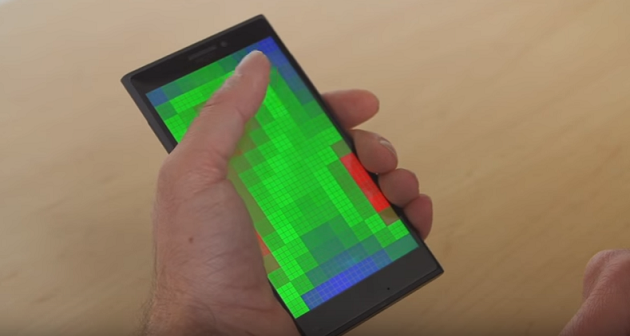
                Microsoft has unveiled an experimental touchscreen which you don’t even have to touch to use. The innovative display uses an array of sensors on the front and sides of the phone to detect the user’s finger when it’s hovering above the screen. This opens up a range of interesting new functionalities – for example, when playing video, the controls to pause, play and fast-forward only appear when the user goes to touch the screen, and disappear when the phone detects the finger has moced away. Browsing webpages becomes a lot smoother, as well – hyperlinks, which can make a page look busy and confusing, aren’t visible when a user is just reading an article. When they move to tap the screen, however, the links become visible, with more appearing as the user’s finger moves around the display.